Mentoring
Open, student-driven, peer-mentored research
Two things shape how the lab runs: joining shouldn’t depend on a student’s record, and making progress in it shouldn’t depend on one person. There’s no minimum GPA, declared major, or prior coursework to join, and group meetings are open to anyone interested, not just current members. The group spans first- through fourth-year students and a range of majors — students from Mathematics and Data Science have become just as central to the group as Chemistry majors, particularly as the computational side of the lab’s work has grown.
Most projects carry two or three students at once, so the first person a student asks a question is usually a peer, not the PI. Third- and fourth-year students present their work in group meetings each semester, and the lab looks for chances to connect students with the broader scientific community, through field trips, visiting scientists, and conference travel.
That same openness extends to the questions students bring with them. Single-sided NMR’s portability means almost any sample is fair game, and the lab deliberately leaves room for ideas nobody planned for going in — mentoring, in that case, mostly means supplying the resources and guidance to help an idea become a real project. Recent examples include characterizing pore structure in archaeological pottery with a local public archaeology group, studying the rehydroxylation of archaeological ceramics as a possible dating method, developing synthetic bone-mimicking materials to study osteoporosis, and testing whether bacterial biofilms measurably change the water around them.
Because the group works across experiment, hardware, and computation, the specific skills students pick up vary by project, but tend to include some combination of experimental design, electronics and instrument building, Python/MATLAB programming, molecular dynamics simulation, literature review, and data analysis. Other skills students develop along the way include reading an error message carefully, tracing a citation back to its source, and communicating results clearly to people outside the lab.
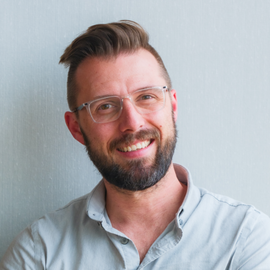
Tyler Meldrum
Associate Professor of Chemistry, Director of Undergradate Research in Chemistry
Physical chemist and teacher, founder of spinlab. Researches NMR, materials, and student-driven discovery.